
Wednesday, September 24, 2008

Tuesday, August 26, 2008
Beijing Olympics Wrap-Up With Brenda Wood
Phil Morrison and Keith Williams interviewed on NBC TV for writing a Beijing Olympics song
Friday, April 25, 2008
The World Unity Jazz Ensemble and the Coastal Symphony of Georgia
Selections From WUJE & The Coastal Symphony of Georgia:
(click to listen, right-click to download)
China Skies / In A Chinese Tea Garden - Live
Skylark - Live
WUJE Introductions By Keith Williams
Selections From WUJE's "Hollow Reed" CD:
Hollow Reed
Persian Prophet
Jazz, Latin, Asian, & Reggae in Concert with Symphony Orchestra
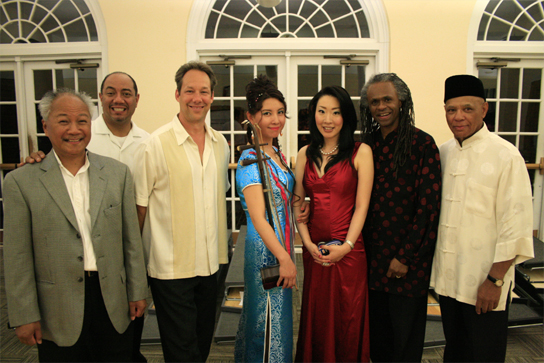
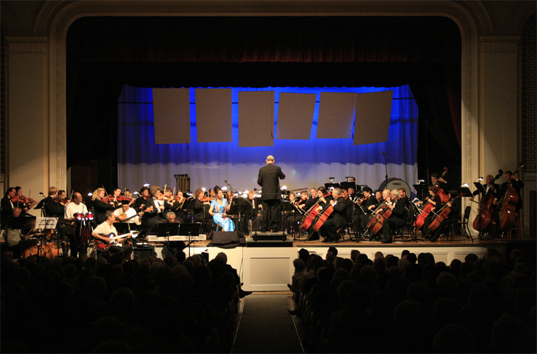
On Monday, April 21 2008, the audience of the Coastal Symphony of Georgia welcomed to the stage the World Unity Jazz Ensemble as part of their “Music of America” program. With the first downbeat the audience knew it was in for a musical experience very different from any other heard or seen in Brunswick, GA. As the beautiful Xiao Hui Ma (pronounced Shaow - Way) from China, graced the stage bedecked in traditional Chinese dress with her erhu (pronounced Ahr-hoo) in hand, the audience welcomed her with befitting applause. This world-renowned artist can be heard on the soundtrack of the popular film "Crouching Tiger, Hidden Dragon" playing the erhu alongside Yo-Yo Ma.
The World Unity Jazz Ensemble (WUJE) began a five song set of original compositions of bassist/composer Phil Morrison which were skillfully arranged for full symphony orchestra by pianist/arranger Keith Williams. This composer/arranger team assembled the jazz oriented WUJE while performing in Asia. On this evening's performance, Xiao Hui Ma was the featured soloist with WUJE and accompanied by the Coastal Symphony of Georgia. It was truly an extraordinary experience to hear Asian flavored melodies played with the haunting and beautiful sound of the erhu, energized by jazz and Latin rhythms performed by world class musicians of many different races and cultures. The only non-original standard tune was the Hoagy Carmichael classic "Skylark" which was exquisitely sung by Kaori Yamada of Japan, whose physical beauty was matched only by that of her voice.
WUJE (woo jay) and Xiao Hui Ma finished their performance with the song Persian Prophet. This tune blended a hint of a mid-east melody with a reggae beat, performed by American, Chinese, Japanese, Puerto Rican, Filipino, Black & White musicians, indicating the potential of a unified human family, while demonstrating that different musical genres (jazz, classical, Latin, Asian, Reggae) can be performed harmoniously. The audience roared to life, applauding the superb performance of the ensemble. Many had never before seen an erhu, yet instantly recognized its earthy, violin-like quality that is sometimes mistaken for a woman's voice. The Songs performed by the World Unity Jazz Ensemble are also featured on their new album entitled “Hollow Reed” which is available on cdbaby.com or locally at Daddy Cate's Coffee in downtown Brunswick, or Moondance Vintage Clothing and Palm Coast Coffee in the village on St. Simons Island.
Noteworthy addition: A new song written by Phil Morrison and Keith Williams has been selected as an official song for the Beijing 2008 Summer Olympic Games!
Friday, February 1, 2008
Pupil of the Eye
(click to listen)
Pupil of the Eye - The source of our vision
Pupil of the Eye - The Creator's gift of sight
A gift for all humanity - Seekers of the light
There are so many things we say that influence the mind
Those hidden little messages that are so hard to find
To show just one example, let's talk about a color
How black is shown as negative in one way or another
Of course we know that's not the case when we refer to white
In fact we use the color white to represent what's right
But those of us who have a tone that's of a darker hue
See Blackness in a different light... a different point of view
Pupil of the Eye - The source of our vision
Pupil of the Eye - The Creator's gift of sight
A gift for all humanity - Seekers of the light
Sounds that enter through the ear - melodies of old
Orchestrating different notes to touch and soothe the soul
A symphone of music creating harmony
Appreciating differences with its diversity
A special walk, that soulful talk flavored with pizzazz
Innovative music - just listen to some jazz
Raggae, Hip Hip, Samba, and don;t forget the Blues
Ways to find expression, years of payin, dues
Pupil of the Eye - The source of our vision
Pupil of the Eye - The Creator's gift of sight
A gift for all humanity - Seekers of the light
The Queen of class and dignity, Oprah - seen and heard
America's classical music from Duke, Diz and Bord
International leadership with strength but always calm
Promoting Peace and Unity... Mr. Kofi Annan
Uplifting words that touch your heart from Maya Angelou
A pioneer in medicine... Dr. Charles Drew
Arthur Ashe and Jim Brown, speaking out, they weren't afraid
Marva Collins and Bill Cosby.. helping youth make the grade
Malcom, Martin, Mandela... standards for the world
To make the world a better place for every boy and girl
Beige, Brown, Black and White, a variety of colors
Yet one human family... all sisters and brothers
Bearing burdens from the past - enslaved and sometimes sold
Enduring untold horrors while survival was the goal
With faith and perseverance - despite the racist drama
Came forth a U.S. President - his name...Barack Obama
The earth's human garden we see before out eyes
Representing Unity, if we'd only realize
But as we care for flowers, so none will be neglected
Hamnity is much the same, we all must be respected
Pupil of the Eye - The source of our vision
Pupil of the Eye - The Creator's gift of sight
A gift for all humanity - Seekers of the light
Seekers of the light... Baha'u'llah... World Unity
alternate lyric
(But darkness equals mystery a search for the unknown
Seeking Spirituality... we know we're not alone)
c 1990 Phil Morrison
The central theme of the Baha'i Faith is the Oneness of Humankind. The Prophet-Founder Baha'u'llah spoke out at a time when the color black had a negative connotation that contributed to racist attitudes. The Baha'i writings remind us that the pupil of the eye, the source of our vision is indeed black thus helping to put in balance the social implications of the color spectrum.
Thursday, January 24, 2008
Matsumoto No Yume

Japan…is where Phil Morrison, while serving in the military, first started to develop as a jazz musician! As the years passed on, Phil had the opportunity to perform professionally in Japan many times and the fondness for that country grew. Although there were performances in Tokyo and Osaka, the small city of Matsumoto and its people, exemplified the warm spirit and friendliness of that island nation.
That spirit inspired Phil to compose a piece to be recorded using traditional Japanese instruments, the Shakuhachi and Koto. It was superbly arranged by world class arranger Keith Williams and performed by Japanese musicians, some of whom were students at the Suzuki school, along with American jazz musicians. The result "Matsumoto No Yume"(Matsumoto Dreams) was extraordinary as you can hear by clicking below. https://www.broadjam.com/
"Matsumoto No Yume"(Matsumoto Dreams)
Striving to be of Service to Humanity by Promoting International Harmony through Music!
Monday, January 21, 2008
Reparations For Slavery in America...Yes or No?

It is true what the senator said... that white folks who are currently living in the USA had nothing to do with the scourge of slavery back in the 18th and 19th centuries. However many of their white ancestors benefited from the free labor of black enslaved men, women, and children who were dehumanized as well as being prohibited from becoming educated. They also suffered all kinds of indignities which contributed to the current condition of black folks and the disparities between whites and blacks in present-day society.
The economic fruits of that slave culture translated into the wealth which was accumulated from the free labor of slavery and allowed for future generations of whites to benefit economically, educationally, and culturally. Given that history, it is not surprising that there is such a gap between blacks and whites in our present-day society in terms of both wealth and health. Hopefully this gives greater understanding to the terms we refer to as "generational wealth" or the "wealth gap" as described below
If you are poorer, you live in a poorer neighborhood! If you live in a poorer neighborhood, your children go to a poorer school which results in a poor education. With a poor education, you are ill-prepared for a well-paying job as an adult so you necessarily reside in a poor neighborhood to raise your family in the midst of adverse conditions such as crime, drugs, violence, toxic air, and water, etc. Even though that situation exists, many, if not most black folks, rise above those obstacles to raise their families to be upstanding citizens. However, given the shameful history mentioned above, there is still the general perception that if you are black you are somehow suspect and treated as such, particularly as it relates to police brutality, the criminal justice system, housing, employment, and education.
Yes, But to correct this country’s original sin of slavery, we had a Civil War, civil rights legislation and elected a black president says the Senator... implying that all things are now equal for all people in the USA...what’s the problem? To that, I am reminded of what the legendary coach of Georgetown basketball John Thompson said some years ago -“There is nothing more unequal than treating unequals as equal!”
I firmly believe that some thoughtful form of reparations could be a way to help rectify this problem of racial injustice and the inequities that pervade our society!
Although sending money to organizations or even individuals in the black community might be part of a reparations program, that is not what I am advocating!
My suggestion would be to upgrade the black communities in terms of high-quality schools, libraries, hospitals business opportunities, environment, art centers, infrastructure, recreation, health centers, and transportation...comparable to what you might find in any high-end suburban community!
Child care, adult education, job opportunities, etc. would also be included! Of course, it would cost a lot of money but it cost a lot of money to get us to the Moon, not to mention the Marshall plan and other projects undertaken by this country!
The meaning of “reparations” as defined in Webster’s dictionary includes “the act of making amends for a wrong.” The word itself allows for great latitude concerning its definition plus I allow in my piece for additional latitude when I say “some thoughtful forms of reparations” could be helpful.
Given the controversy swirling around this term, I feel a need to clarify what is meant when I use the word “reparations”, being aware that others may use that word with a different meaning in a different context! Thank you for your interest regarding this timely topic!
Phil Morrison
Striving to be of Service to Humanity
by Promoting International Harmony through Music
by Promoting International Harmony through Music
Wednesday, January 16, 2008
Religion: Some Thoughts

Religion: Some Thoughts
By Phil Morrison
The most common reason people belong to a certain religion is because of family tradition or cultural heritage. People tend to stay in that religion because they're generally more comfortable with familiar customs and practices or they are influenced by people who are proponents of that religion; further search is thus discouraged.
The teachings or scriptures of any religion validate that religion for its members. To use those same scriptures, as many of us do, to convince nonmembers of that validity may not have the same effect because
the credibility given to those scriptures is not the same as for a member. When adherents of a certain faith say that their spiritual book contains unrefutable truth, that may be so; however, semantics, context, relativity and interpretation of the giver, receiver and translator of the readings should be considered.
If the common foundation of most religions is what we call God, then we would expect the purpose of those religions to be Godly, which they seem to be in that they teach love, peace, high moral standards, prayer, the sanctity of family, etc. The differences among the various religions seem to be in their daily practices or social customs such as the Sabbath, clergy, marriage, role of women, diet, burial, divorce, etc. These social teachings are, for the most part, based on the message given by the founder of each religion or author of its holy book or books. The station of the founder is usually considered by that religion's membership to be higher than the major figures of other religions. Here, again, is where its own holy book is used to justify or verify that contention. If we are already believers in that claim, and that religion, it is easy to find passages in its holy book to support our belief but even statements that appear to be unambiguous deserve serious scrutiny when seeking knowledge, paying particular attention to context. An example of the type of context I'm referring to may be when a mother tells her small child to stay away from the hot stove because the child could get burned if it is too close. The same mother may tell an older child about the benefits of the stove as in cooking or providing warmth. In one context, the stove represents something bad and in the other something good, so, depending on what I want to emphasize, I can extract from "the mother's writings" that the stove is either good or bad.
The development and understanding of a human being from childhood to adulthood may be compared to the development of humanity. A young child does not understand advanced English, so the adult speaks to that child in terms she or he understands. By the same token, humankind in the past was underdeveloped as well (we had no knowledge that the earth was round nor did we have the ability to travel as we do today, etc.). That being the case, it would stand to reason that an all-knowing God would impart information relative to the comprehension of the people of that time period.
Consider this as a possible approach that God might use to spread His message (which we call religion). Let's compare it to our educational system whereby information given to the first grade students is more simple and in a language less difficult than the second or higher grades. In a religious context, the teachers (i.e. Moses, Jesus, Mohammed, Buddha, Krishna, etc. ) may have had equal knowledge but they only imparted what was appropriate or digestible for the times, condition, and area in which they had appeared. If we accept this as God's plan, then it would mean that all people of all religions can look at all the divine teachers as equal and receiving their teachings from the same source with no religion being exalted over the other. That could have a unifying effect as far as religion is concerned (although one may ask why in Christianity, for example, are there so many denominations when there is only one Christ?). The above scenario might bring about a challenge to the person who claims to be the most recent of God's messengers because his or her message could make the more established religions, particularly clergy, feel threatened or at least uncomfortable. The reason being that the latest of God's teachings purportedly would have been more relevant to contemporary society. Historically, of course, there have been spiritual teachers whose teachings have met with opposition, but they endured and formed the foundations for several great civilizations. The decline of a civilization could be the time when a new divine teacher appears with regenerative, practical guidelines for a new era. Thus God's cyclical plan would be perpetuated.
What I have just put forth may or may not have a ring of logic to it; however, realistically most people do not approach religion logically or by using their heads but via the heart or emotions. As alluded to previously, if you've belonged to a certain religion since birth, you are generally emotionally attached to that religion regardless of what anyone says. The aspects of our religious background that we are most attached to are love for the divine head of our faith and the traditional customs (prayer, songs, ceremonies) that we practice.
These elements are, for the most part, unique to our particular religion and would be difficult to give up. If, on the other hand, we were asked to adopt new or updated religious teachings that would benefit humankind as a whole without giving up all our religious traditions or love for the spiritual leader we grew up with, we might be more open to that prospect.
When discussing religion, it is not only the so-called religious people who are concerned about the subject, but there are those who claim to be nonreligious who are also interested. There are many who call themselves atheists or agnostics or those who prefer not to identify with any formally organized group or label. Because there have been many conflicts throughout history that rightly or wrongly have been associated with religion, many have rejected the notion that religion is a positive force for society. I am reminded of a quote that has left an impression on me and I paraphrase here
"...if religion be the cause of divisiveness, enmity, strife or hypocrisy, then it would be best to be without religion and to withdraw from such a religion would be a truly religious act! " Even the definition of the word God can be so nebulous that the God an atheist does not believe in may be the sameGod that a theist does not believe in.
I believe many people who call themselves nonreligious are actually religious in the true sense of the word. This is often demonstrated by their deeds that are of benefit not only to the people with whom they come in contact, but frequently to all of humanity. To convince them that religion is an entity that promotes growth and harmony for society as well as the individual would require for the most part, an intellectual approach because they do not have an emotional attachment to religion. However, at some point the heart may be the determining factor of their views of their religion.
It is doubtful to me that anyone can actually prove
their religion comes directly from God, although
a convincing argument may be given to support such a claim. I do believe that there are religions which,
regardless of whether or not we believe they come
from God, are sufficiently godly in their purpose and practice that we should not be overly concerned with
their origins. Unfortunately, people have a tendency
to be more concerned with titles, trappings, and
traditions rather than with substance or results. If we truly believe in God, then we should accept that all things, or at least those things of a positive nature, are from our Creator.
Whether we are members of a religious group or not, religion impacts upon the lives of everyone around the world so we should know as much as possible about all religions. Knowledge of any subject, particularly those that directly relate to society, can be very useful in developing understanding and tolerance as well as appreciation for cultures that are different than our own. Religion, I would say, is one of those subjects.
Phil Morrison.
Subscribe to:
Posts (Atom)
